Graham Stringer


This series of work is inspired from English Nursery Rhymes from an original nursery rhyme book. The original rhymes (as illustrated above) have been re written by Graham to reflect modern social themes. However these ‘new rhymes’ are based on selected rhymes found in that original book - respecting the rhythm, repetition, characteristics and poetic narration.

Les comptines que vous voyez (initialement écrites en anglais) ne sont pas des textes originaux, mais ont été écrites par Graham afin de refléter des thématiques sociales contemporaines. Cependant, ces « nouvelles comptines » sont basées sur une sélection de comptines présentes dans cet ouvrage original — en respectant le rythme, la répétition, les caractéristiques et la narration poétique.

Principally tailored to entertain children, the rhymes nearly always contain an explicit moral. Sometimes it is difficult to understand the true meaning, however research reveals that some rhymes date back over 600 years and almost certainly make hidden reference to social, political and religious events such as the Great Plague of London
Principally tailored to entertain children, the rhymes nearly always contain an explicit moral. Sometimes it is difficult to understand the true meaning, however research reveals that some rhymes date back over 600 years and almost certainly make hidden reference to social, political and religious events such as the Great Plague of London in 1665 (Ring-a-ring-o’-roses), the 13th century ‘wool tax’ levied by King Edward I (Baa Baa Black Sheep), and religious turmoil in the 16th century (Goosey Goosey Gander).
Principalement conçues pour divertir les enfants, ces comptines contiennent presque toujours une morale explicite. Il est parfois difficile d’en saisir le sens profond ; cependant, des recherches révèlent que certaines comptines remontent à plus de 600 ans et font presque certainement référence, de manière dissimulée, à des événements sociaux, politiques et religieux tels que la Grande Peste de Londres en 1665 (Ring-a-ring-o’-roses), la « wool tax » (impôts sur la laine) du XIIIe siècle imposée par le roi Édouard Ier (Baa Baa Black Sheep), ainsi que les troubles religieux du XVIe siècle (Goosey Goosey Gander).

These rough drawings from poor quality online newspaper photos made me think about the possible conditions of detainment and what someone in this situation might experience ?
From the BBC (Nov 2024) A student movement organisation first published the video of the arrest, reporting that Ms Daryaei had an altercation with security agents over not wearing a headscarf, leading to her undressing during the scuffle.
Iranian authorities at the time said Ms Daryaei was "sick" and had been taken to a psychiatric ward. It is not the first time Iranian authorities have branded a woman protesting compulsory hijab laws with a mental illness.

How can one express an idea that draws simultaneously on image, word, rhythm, and social commentary? It’s a question that preoccupies me. Then, in what Bob Ross might have called a “happy accident,” I came across a very old nursery rhyme book. It struck me that this could be the perfect medium—something that operates both visually and deep within the collective psyche—through which to explore a form of social commentary.
Comment exprimer une idée qui s’appuie à la fois sur l’image, le mot, le rythme et le commentaire social ? C’est une question qui me revient sans cesse. Puis, dans ce que Bob Ross aurait appelé un « heureux accident », je suis tombé sur un très vieux livre de comptines. Il m’est apparu que ce médium pouvait être idéal : quelque chose qui agit à la fois visuellement et au plus profond de l’imaginaire collectif, permettant d’explorer une forme de commentaire social.

From the images drawn from security footage of that event in Iran Nov 24 seen all over the world here is my painting on forceable detainment - 'Lyric' takes inspiration from the well known children's nursery rhyme :
Little Miss Muffet
Sat on a tuffet,
Eating her curds and whey;
There came a big spider,
Who sat down beside her
And frightened Miss Muffet away
À partir d’images issues de caméras de surveillance visibles partout dans le monde (nov 2024), voici mon interprétation de la détention forcée — « Lyric » s’inspire de la célèbre comptine pour enfants :
"Mademoiselle Muffet
Sur son petit coussinet,
Grignotait son lait caillé ;
Quand une grosse araignée
Vint tout près se poser —
Et Muffet s’enfuit, apeurée."
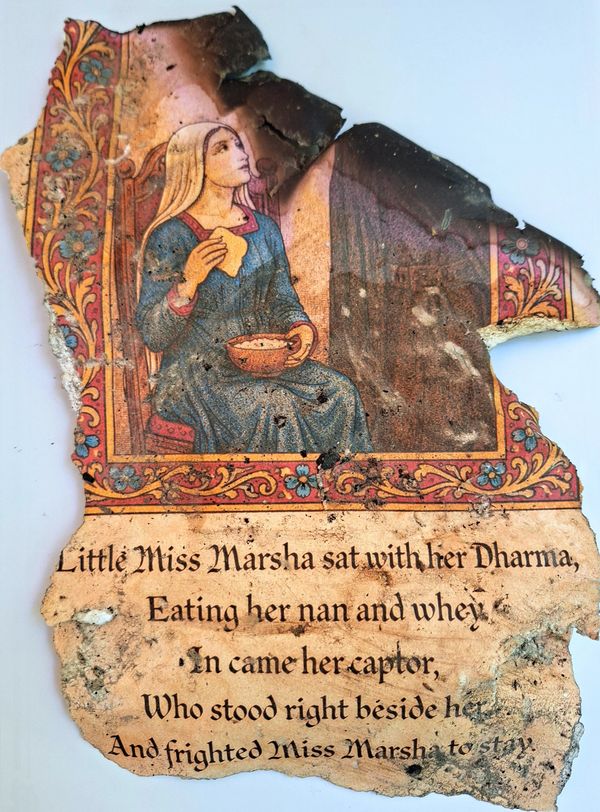
From the rhyme 'Little Miss Muffet' my painting (above) about imagined detention inspired the following text -
Little Miss Marsha*
Sat with her Dharma,
Eating her nan and whey;
In came her captor,
Who stood right beside her,
And frightened Miss Marsha to stay
* see Mahsa Amini protests
Inspiré de la comptine « Little Miss Muffet », mon tableau sur une détention imaginée a donné naissance au texte suivant :
"Petite Miss Marsha*
Assise avec son dharma,
Mangeait son pain et son lait ;
Vint alors son ravisseur,
Qui se tint tout près d’elle —
Et força Marsha à rester, en frayeur."
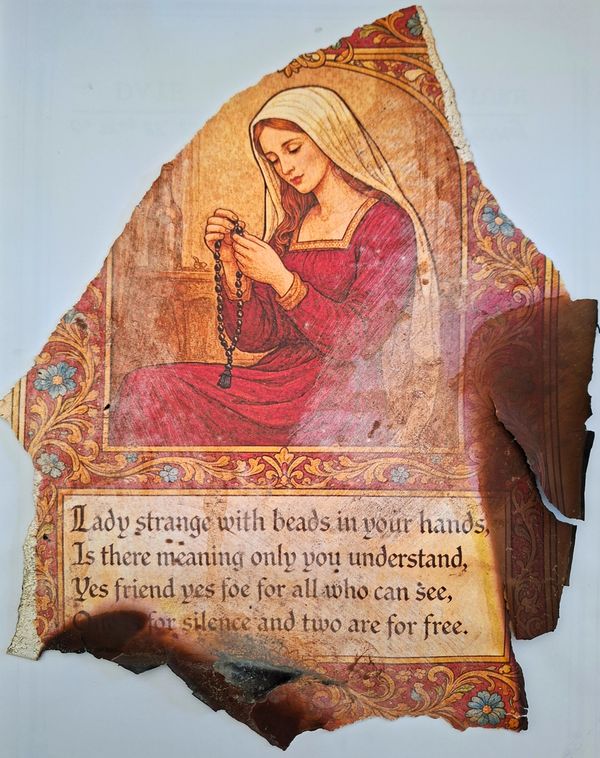
Inspired from another traditional rhyme I rewrote the original to capture my vision about continued detainment :
Lady strange with beads in your hands,
Is there meaning only you understand,
Yes friend, yes foe for all who can see,
One is for silence and two are for free.
Inspiré d’une autre comptine traditionnelle, j’ai réécrit l’original pour exprimer ma vision de la détention prolongée :
"Dame étrange, perles en tes mains,
Quel sens secret caches-tu si bien ?
Oui, ami, ennemi — pour qui voit clair,
Une pour se taire, deux pour l’air."
I have tried to visually capture the tone and structure of the previous nursery rhyme to expose how control can be normalised - the beads play a critical role in linking the idea of a children's counting
song to the idea of survival under coded conditions.
J’ai essayé de capturer visuellement le ton et la structure de la comptine précédente afin de montrer comment le contrôle peut être banalisé. Les perles jouent un rôle essentiel en reliant l’idée d’une chanson enfantine de comptage à celle de la survie sous des conditions codées.
If wishes were pots,
She'd have her grace,
If vases were words in knots,
She'd surely tie them in place.

"Si les vœux étaient des pots,
Elle trouverait sa grâce,
Si les vases étaient des nœuds,
elle les nouerait en place"
Here I am trying to explore contemporary issues such as domestic vulnerability, hinting at how people are still expected to contain; manage or 'tie up' their own vulnerability (even if it is inherently breakable)
j’essaie d’explorer des enjeux contemporains tels que la vulnérabilité domestique, en suggérant que l’on attend encore des individus qu’ils contiennent, maîtrisent ou “attachent” leur propre vulnérabilité (même lorsqu’elle est, par nature, fragile et susceptible de se briser)
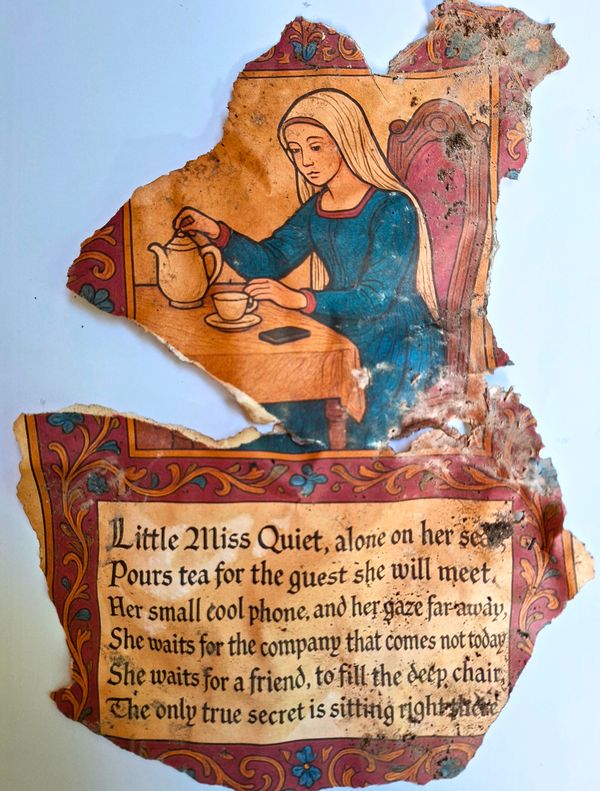
"Mademoiselle Discrète, seule sur son siège,
Verse le thé pour l’invité qu’elle espère en cortège.
Son petit téléphone froid, et son regard lointain,
Elle attend la visite qui ne vient pas ce matin.
Elle attend un ami pour combler le grand fauteuil,
Le seul vrai secret repose là, à son seuil."

A social ritual about absence, something of a study about contained solitude, asking the question if what she is waiting for externally already exists internally ? Is it about the tension between presence and absence ?
Un rituel social autour de l’absence, une forme d’étude de la solitude contenue, qui pose la question : ce qu’elle attend à l’extérieur existe-t-il déjà en elle ?
S’agit-il d’une tension entre présence et absence ?
The painting exposes the farce of modern power: authority issuing decrees into an echo chamber of obedient voices. Advisors nod in rehearsed loyalty, mistaking compliance for virtue. Even the courts, once a safeguard, seem to tilt toward the same delirium—where the performance of justice replaces its practice, and dissent is quietly smothered.
Le tableau met à nu la farce du pouvoir moderne : une autorité qui décrète face à une chambre d’écho de voix dociles. Les conseillers acquiescent avec une loyauté répétée, confondant l’obéissance avec la vertu. Même les tribunaux, jadis garants, semblent basculer dans le même délire — où la mise en scène de la justice remplace sa pratique, et où la dissidence est étouffée en silence.
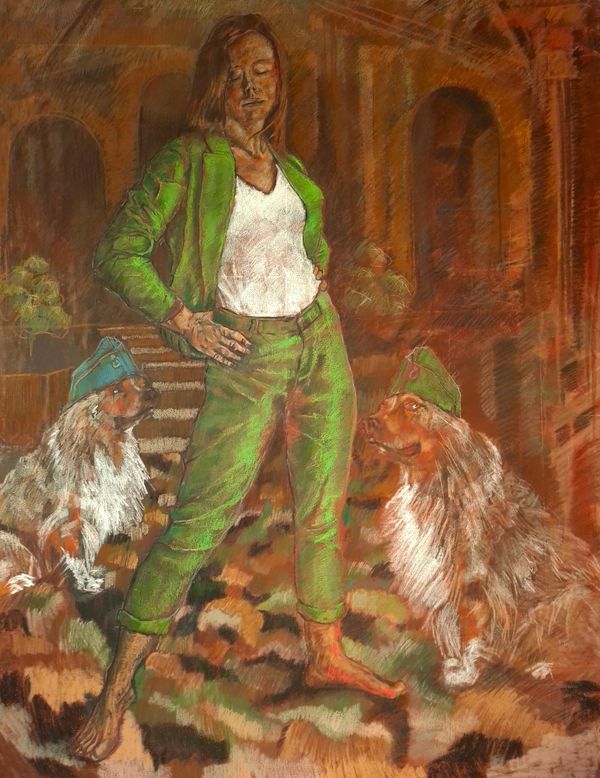
"Tamp Camp et son gars
Plop plop sur leurs fesses, tout bas
Tampy là, tout près d’ici
Et Coco juste en face, assis
« Chien, » dit Tampy,"
« Tu peux garder rancune ?
Ou gronder un juge en lune ? »
« Ouaf, » dit Coco
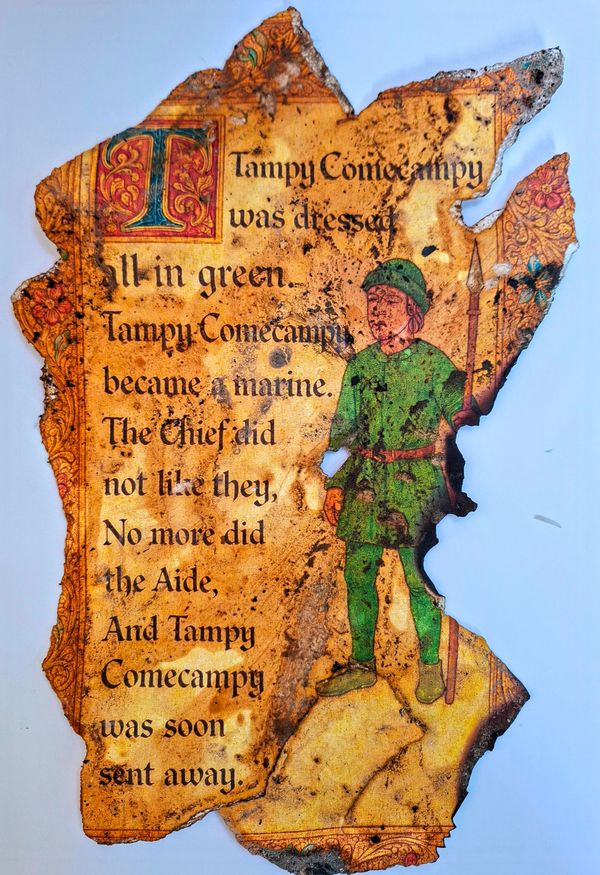
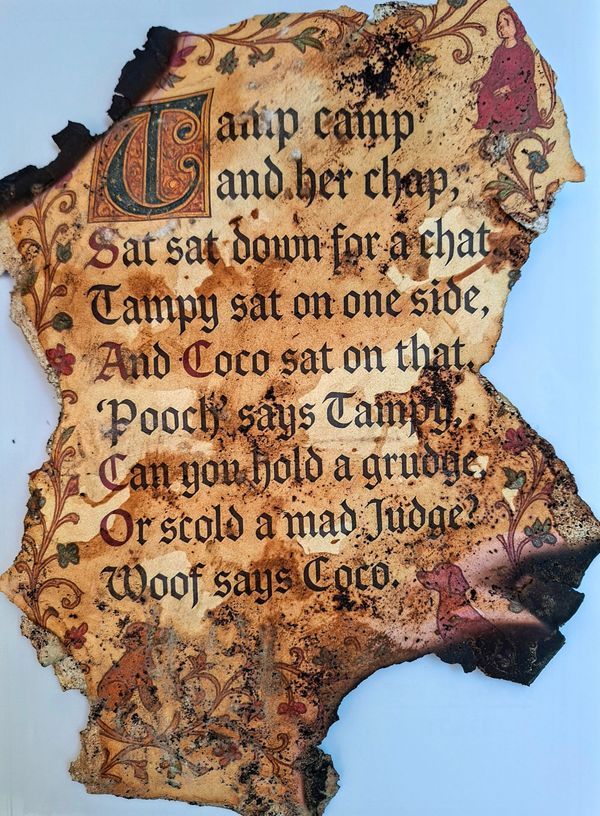
Taken from the original rhyme -
Hector protector was dressed all in green;
Hector Protector was sent to the Queen,
The Queen did not like him,
No more did the king;
So Hector Protector was sent back again
(the rhyme's precise origins remain unclear—potentially rooted in folk traditions without a confirmed historical event )
Although the original rhyme exists outside any specific historical context, this adaptation is firmly rooted in contemporary events. It deliberately alludes to a resurgence of regressive policies within the military, where diversity is increasingly challenged by ill-informed senior politicians and their advisers. The theme of inclusivity is underscored through the intentional use of the gender-neutral pronoun “they.”
Bien que la comptine originale ne s’inscrive dans aucun contexte historique spécifique, cette adaptation est fermement ancrée dans les événements contemporains. Elle fait délibérément allusion à une résurgence de politiques régressives au sein de l’armée, où la diversité est de plus en plus remise en question par des responsables politiques et leurs conseillers insuffisamment informés. Le thème de l’inclusivité est renforcé par l’usage intentionnel du pronom épicène « they ».
"Tampy Comecampy vêtu de verdine,
Tampy Comecampy devint marine.
Le Chef ne les (they) aimait pas,
Pas plus que l’Aide,
Et Tampy Comecampy fut bientôt renvoyé."

Hans Christian Anderson was a prolific Danish author famous for his fairy tales written for children and first published in 1835. His stories make reference to true worth often as a function of virtue, resilience and internal authenticity and provide direct inspiration for Graham's ‘black series’ representing a body of work which is conc
Hans Christian Anderson was a prolific Danish author famous for his fairy tales written for children and first published in 1835. His stories make reference to true worth often as a function of virtue, resilience and internal authenticity and provide direct inspiration for Graham's ‘black series’ representing a body of work which is conceived in the manner of a series of “modellos”; it is therefore part of a continuing project to further investigate technique, human form and sacrifice

....célèbre pour ses contes de fées destinés aux enfants, publiés pour la première fois en 1835. Ses récits évoquent souvent la véritable valeur comme étant liée à la vertu, à la résilience et à l’authenticité intérieure. La « série noire » de l’artiste constitue un ensemble d’œuvres conçues à la manière d’un « modello » (l'étude préparatoire)
Imagined from the tales of Hans Christian Anderson the series of 'black works' represent the Graham's personal response to specific tales. These images are not literal transpositions but capture the key themes of Anderson’s work - inner worth, sacrifice, spiritual reward, and resilience.

“The Little Match Girl” - a poor barefoot girl tries to sell matches on the street, fearing her abusive father she huddles in an alley and lights the matches for visions of comfort and warmth. She dies of the cold on the street but is carried to heaven thanks to her visions in the flames of the matches.
« La Petite Fille aux allumettes » – une pauvre fillette pieds nus tente de vendre des allumettes dans la rue ; craignant son père violent, elle se recroqueville dans une ruelle et allume des allumettes pour faire apparaître des visions de chaleur et de réconfort. Elle meurt de froid dans la rue, mais est emportée au ciel grâce aux visions dans les flammes.

“The Story of a Mother” - after watching over her sick child for 3 days, Death enters her home and takes her child. The mother tries to make extraordinary maternal sacrifices to find the way to reunite with her child, and only at the end of the tale does she realise that she must submit to God’s will to allow death to take her child into the unknown peaceful world.
« L’Histoire d’une mère » – après avoir veillé son enfant malade pendant trois jours, la Mort entre chez elle et emporte son enfant. La mère entreprend des sacrifices maternels extraordinaires pour tenter de le retrouver, et ce n’est qu’à la fin qu’elle comprend qu’elle doit se soumettre à la volonté de Dieu et accepter que la mort emmène son enfant vers un monde inconnu et paisible.

“Anne Lisbeth” - tale about a proud woman who abandons her son; the son lives a hard, poor life and drowns at sea. Lost at sea and unburied, the Sea Ghost spirit of the son haunts Anne Lisbeth. Seeking forgiveness she desperately tries to dig a grave with her bare hands on the sea shore, one year later she is found at the altar of the church with the last sunbeams of light shining upon her - at this moment she finally retrieves her soul and achieves redemption.
« Anne Lisbeth » – conte d’une femme orgueilleuse qui abandonne son fils ; celui-ci mène une vie dure et misérable et se noie en mer. Perdu en mer et sans sépulture, l’esprit marin du fils hante Anne Lisbeth. En quête de pardon, elle tente désespérément de creuser une tombe à mains nues sur le rivage. Un an plus tard, elle est retrouvée à l’autel de l’église, baignée par les derniers rayons du soleil — à cet instant, elle retrouve enfin son âme et atteint la rédemption.
“She Was Good for Nothing” - The story follows a poor washerwoman who struggles to raise her son after being abandoned by her lover. She works hard in the freezing river, sometimes drinking to keep warm, which causes the wealthy Mayor and the townspeople to look down on her, deeming her "good for nothing". The tale ends by the assurance to her son that her dead mother was in fact a worthy woman. The tale challenges the judgements of society.
« Elle ne valait rien » – l’histoire suit une pauvre lavandière qui lutte pour élever son fils après avoir été abandonnée par son amant. Elle travaille dur dans la rivière glacée, buvant parfois pour se réchauffer, ce qui pousse le riche maire et les habitants à la mépriser, la jugeant « bonne à rien ». Le conte se termine par l’assurance donnée à son fils que sa mère défunte était en réalité une femme digne. Le récit remet en question les jugements de la société.

“The Red Shoes” - a vain girl is obsessed by red shoes and against her guardian’s orders wears them to church - she is cursed to dance uncontrollably, and ultimately demands that her feet are severed to find redemption in repentance.
« Les Souliers rouges » – une jeune fille vaniteuse est obsédée par des souliers rouges et, contre les ordres de sa tutrice, les porte à l’église ; elle est alors condamnée à danser sans contrôle et finit par demander que ses pieds soient coupés afin de trouver la rédemption dans le repentir.

“The Little Mermaid” - a story about a mermaid who wants to become human, and consumes a potion from the Witch to have human legs although she is subject to pain as if walking on knives. Failing to marry her beloved prince she falls into despair knowing that death now awaits - the Sea Witch offers a dagger to kill the prince and allow the blood to drop upon her feet which would allow her to become a mermaid once again. She refuses and because of her selflessness will attain one day the kingdom of god.
« La Petite Sirène » – l’histoire d’une sirène qui souhaite devenir humaine et boit une potion de la sorcière pour obtenir des jambes, bien qu’elle ressente une douleur comme si elle marchait sur des couteaux. Ne parvenant pas à épouser le prince qu’elle aime, elle sombre dans le désespoir, sachant que la mort l’attend. La sorcière des mers lui offre un poignard pour tuer le prince et laisser couler son sang sur ses pieds afin de redevenir sirène. Elle refuse, et grâce à son abnégation, elle atteindra un jour le royaume de Dieu.

